Music for nobody
The misanthropy of slop jazz.
(15 minute read)A couple of years ago, I remember being served a thumbnail on my YouTube home feed: a dithered whiskey glass, half-full, with a bright red maraschino cherry on its rim floating against a soft Neptune-blue background. A composition, a display of color straight out of a vintage magazine. Nothing piques my interest like a visual, so I bit and was dropped into a warm, loungey jazz number. By the timeline, it'd be an hour-long set.
Out of creative reverence, I gave it the floor. I casted the video to my living room television and sat myself comfortable on the couch across.
The first track played, sweet and relaxing. Complimented, elevated, even by this venue; surrounded on all sides with verdant houseplants, Marketplaced Lane and Natuzzi furniture, a Bang & Olufsen RX2 on a Fischer cabinet flanked by Technics in walnut veneer. The second track played, sweet and relaxing. I decided to dig in a bit on this artist, maybe turn up a used Discogs listing that I could spin on a future weekend soirée. Oddly enough, my search came back empty-handed; I like to believe my years collecting vinyl would make me somewhat adept at finding musicians. But even with all the tricks I knew, zip. The third track played, sweet and relaxing.
Or, was it the fifth? Sixth maybe? Nudging the seeker on the video put me on...eighth. Eighth. Six tracks played under my nose and in that time, nothing the artist laid down tapped me on the shoulder so as to say "hey, eyes up!"
While I was here in the UI, I decided to skip forward to the next track just to see if I could reasonably pick the next one out of a lineup. But no, not the ninth, not the tenth, not at any point through to the end of the hour-long set did any sound, any phrase break the layer of simple syrup dripping out of my soundbar.
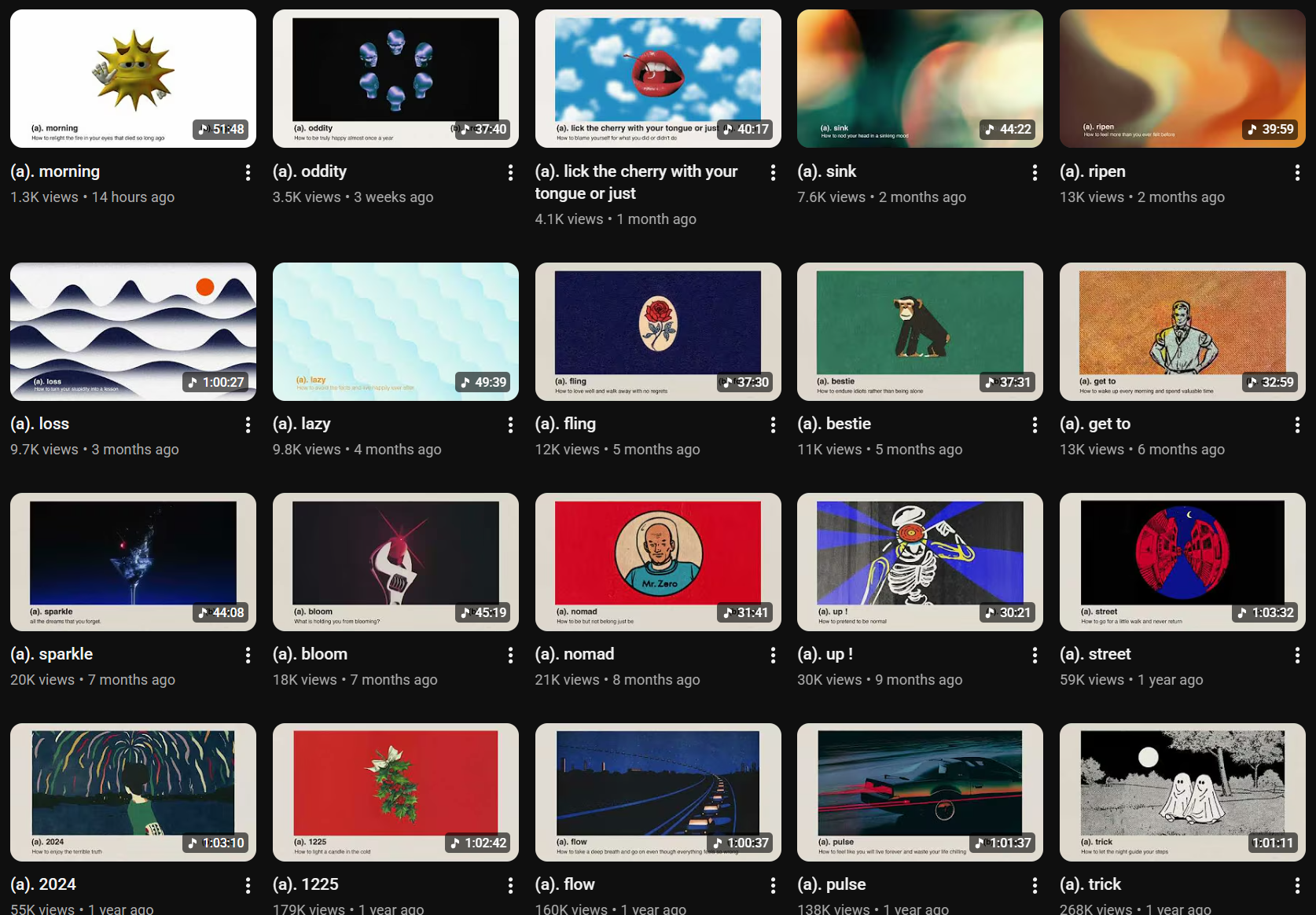
Only on the artist's YouTube page would all become clear. A channel, about a year old, with dozens of sets. In every single one, there was no list of personnel, no producers, no writers. I picked one at random from the pile; the music played, sweet and relaxing and...empty.
The ruse
I was already aware of tools like Udio, being in software it's impossible not to have a conversation about it, especially when I bring up my own music in those compile-time in-between moments on the Zoom call.
But this would be the first time in my experience that a channel in my recommendations would attempt to pass itself off as a musician, as an artist.
That isn't to say that I hadn't seen slapfights already, AI power-consumers demanding artistic legitimacy from an audience that has reached consensus that there is little creative merit to putting a Hot Pocket in a microwave, and even less so in the tiresome rhetoric that such an act warrants reverence as a chef. It simply isn't sufficient for the AI apologist to take haven with like-minded...creators...who share the same fantasies of inevitability. No, it is the external acknowledgement from the creative community broadly that they crave most deeply.
But this channel embroiled itself in a more bold deception by avoiding the question altogether, carrying on blissful without acknowledging any of the more perceptive comments gesturing toward the sameness of each track and the sheer volume of material uploaded in such a short amount of time. Yet on each comment of support, to each morsel of artistic praise, the channel owner made sure to leave a heart.
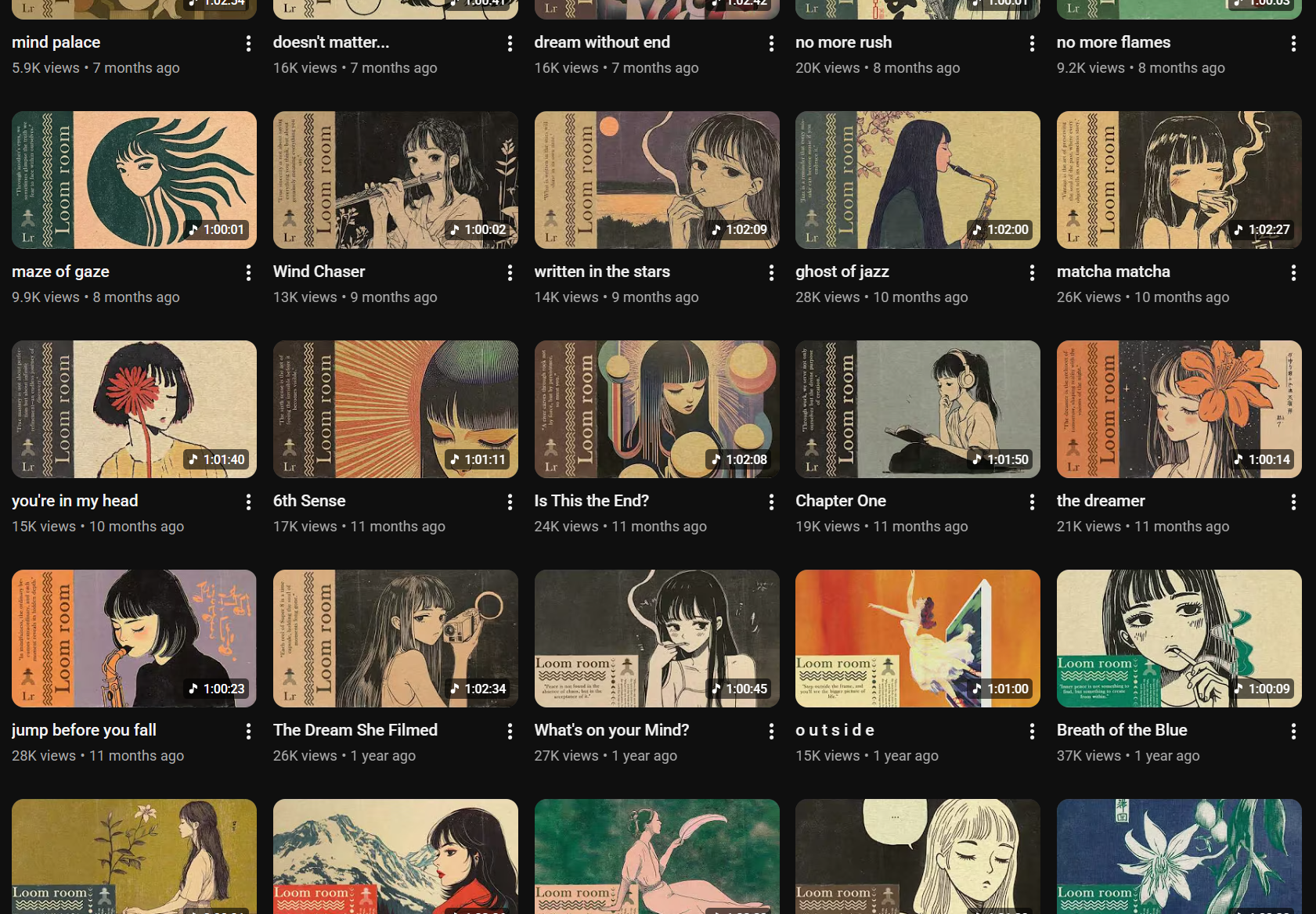
On daring occasion, they would even reply to curious viewers asking "how do you manage to upload so often?" On such occasion they would reply to the tune of "I just love what I do." They love it. Much in the same way, I would imagine, that several copycat channels do with directly lifted vintage ad visuals and the same plastic jazz stylings. I believe that in a double-blind Pepsi-vs-Coke test, no one would be able to tell the difference. It is a distinct possibility the copycats have the same owner.
For these channels, now a cohort, the rules of engagement are this: you don't have to deny anything if you simply don't acknowledge criticism. With this strategy, they reach further than the AI legitimacy-farmers ever could.
The antisocial sound
I strongly suspect that the overlap between these channels and their intended audience is a shared definition of what music is, though the line of thinking to arrive at this conclusion is subtly different between both.
The intended audience
To engineer the intended audience, they must accept that music is only a vibe. The more hollowed, cynical AI takesmiths on legacy social media — which it is not lost on me that they may be simple chat scripts — put it another way: music is good when it makes you feel good. If you are served slop jazz and you weren't offended enough to swipe away, then the slop jazz must be good music. Of course, this garden-variety perspective is belligerently antisocial and not all too surprising coming from its peddlers. It's a perspective that places the individual in the center of existence, that music serves at the individual's pleasure, completely ignoring the fact that all music — including and especially slop music — cannot exist without real people cultivating real skills out of real passion. A musician creates for the same reason people talk: to communicate. In order for slop jazz to be rhetorically identical to jazz made with human creativity, the musician cannot be acknowledged. Without them, what's left is just sound that makes you feel good.
As ever, Cory Doctorow said it best:
The Hollywood writers' strike was precipitated by studio bosses' fantasy of a world without writers – a world where studio bosses don't have to be satisfied with giving harebrained notes to writers who don't bother to disguise their contempt for their bosses' shitty ideas. In a world of AI scripts, the boss decides what kind of movie to make, and a chatbot shits out a script to order, without ever telling the boss that the idea stinks.
The fact that this is an unshootable turkey of a script is of secondary importance. The most important thing is the boss's all-consuming need to avoid ego-shattering conflicts with people who actually know how to do things, who gain power thanks to that knowledge, and who use that power to imply (or state outright) that you're a fucking dunce.
Same goes for the Hollywood actors' strike, and the continued project of cloning actors in software and puppeteering them via chatbot: it's the fantasy of a movie without actors, actors who tell you that the scenario you've spun is an incoherent mess, who insist that their expertise in an art you don't understand and can't perform yourself entitles them to challenge your ideas.
AI is solipsism, the fantasy of a world without people.
Jazz is especially susceptible to being whittled down to a vague aesthetic pastiche on account of its rich, complex history. From the outside, it is the choice of the sophisticate, the perfected sound of elegance. It is this haute evocation that makes these channels attractive; the music doesn't challenge, doesn't demand of the listener, bears no sharp edges. Instead, it goes down easily, agreeably, and analgesically. Its purpose is to be wallpaper, to be undistracting, better enjoyed when given divided attention and at its best when given no attention at all.
To be clear, there are larger forces at play here. Through the capital incentive, almost any cultural item can be boxed up, shelved, and sold (so long as it's deemed morally acceptable by the capital class). When culture is delivered like a commodity, it will be handled like a commodity, made for consumption. Through tireless work and many spiritually-bereft board meetings, there has been a successful redefining of music, not as an expression made by a soul on fire, but as a focus-grouped product made on a factory line and in industrial quantity.
On this premise, genuine inspiration is indistinguishable from its ultra-processed, powdered counterpart; both exist to be consumed, nothing more. The truth is that products don't move the soul. Souls move the soul, souls that are brave enough to try, to sublimate their feelings under penalty of ridicule. To care enough to be moved, to feel deeply is one of the greatest kindnesses one can give their fellow human. Music that makes you feel good is a single color on the palette of musical experience; there's also music that makes you feel loss, grief, music that frightens and disturbs, that is strange, and that points the finger at you in accusation, challenging you to be a better person, and music that reminds you that another human in this world knows how hard it is to be down at the bottom. There's a lot to miss if the north star is "feel good".
In being apathetic to the point that there is no hunger to be moved, to demote a human being to the task of soundtracking your life, that there ought to be no difference worth exploring between the authentic and the artificial, there is no greater contempt.
The "makers"
But here we journey one level deeper to the circle inhabited by those who seek to nurture that contempt. To the slop jazz channel, the listener has no other worth than that which can be extracted, dollars or acclaim. The listener's passing-at-best awareness of the genre is their advantage, relying heavily on the listener's inability to tell that they're listening to middle-of-the-road, anaesthetic mush and especially that nobody cared enough to write it. It is in the channel's best interest to cultivate incuriosity.
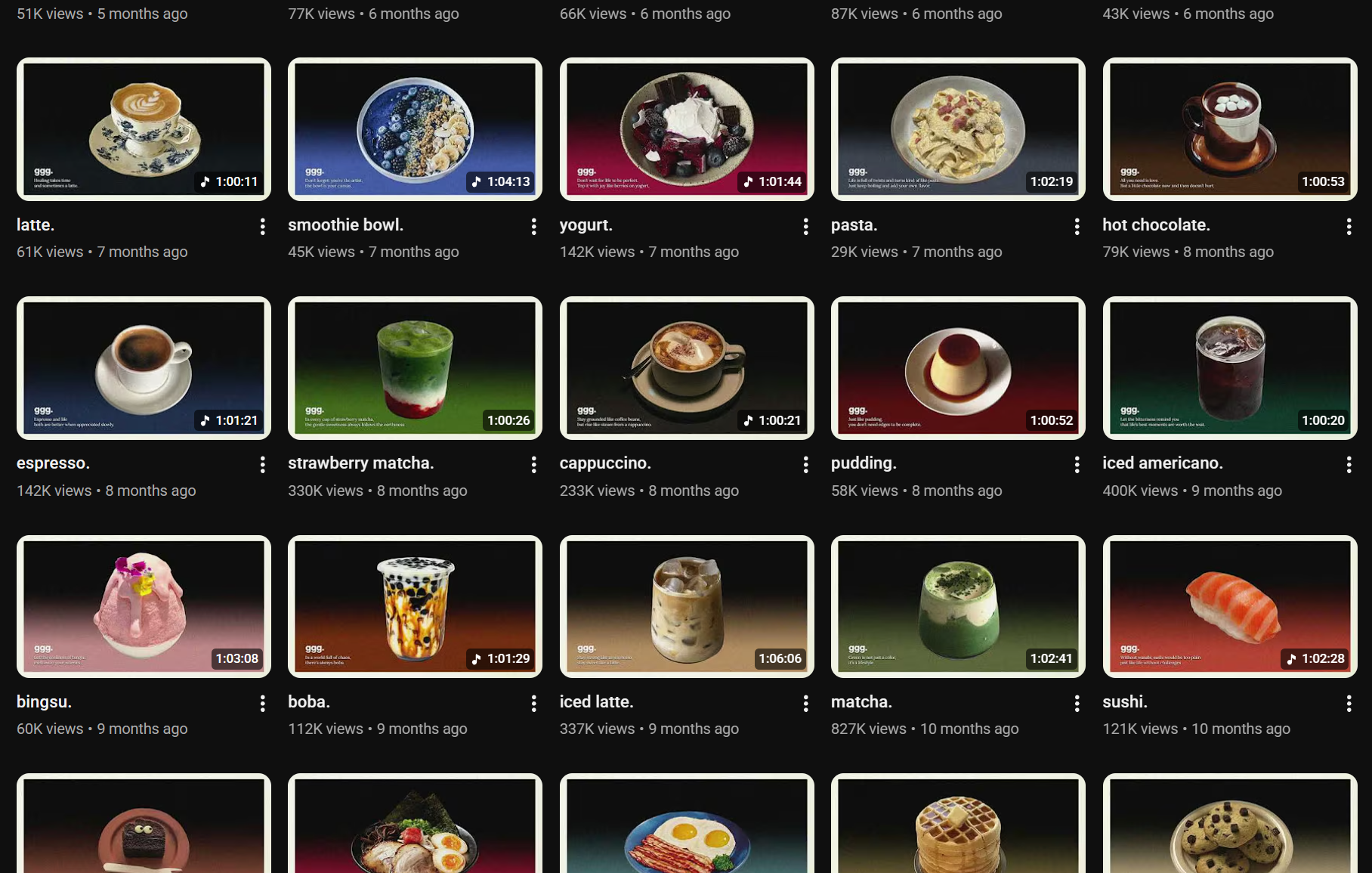
And with the industrial-scale theft of creativity distilled in billion-parameter vats, it's never been easier. At the push of a button, a sickly paste swirls out of the drainpipe that resembles something edible if you just close your eyes and eat. Algorithms will deliver trays of content, yours and others', to a global audience and as long as enough people don't notice when your tray is served down the line, you too could be a successful musician.
All of this and there is still the misery of selecting jazz as the object of fascination. Jazz is the music of struggle, birthed by the victims of the slave trade in the global South and mocked through the advent of the minstrel show, its forebears banned by law from preserving their expatriate heritage through drumming tradition. Even denied, the art grew and transformed into ragtime, into blues, deemed immoral in the time of the Prohibition. And yet it continued to distill and refine through war, finding recognition as one of the highest echelons of musical craftsmanship. Universally respected, though oft misunderstood once the capital class finally decided to institutionalize it. In turning a 99-percenter art form into a 1-percenter commodity, a cultural barrier formed to present jazz as this complex, highbrow ambrosia of the wealthy and successful. It's a mythology that is slowly being dissolved by cross-pollination in areas like jazz-house, hip-hop production, and plunderphonics, but it nevertheless continues to prove stubborn as an accepted cultural fact.
The slop jazz channel exploits this rift to cut to the front of the line. The channel doesn't care for how music is made or have any degree of reverence for the craft, they want the money and the social prestige that comes from being called musician by less critical listeners. Music is a product. Music is a revenue stream. Music makes people like you. In all cases: music is a tool. AI software enables the slop jazz channel to have music, and its capital benefits, without needing to make music.
In summary: to run a slop jazz channel, it is required that you love money, despise art, despise artists, yet desire to be called an artist yourself. You must despise people, yet yearn for their adoration or at the very least their money.
A jazz outsider recommends jazz
I myself am not a trained jazz musician. I didn't grow up listening to jazz, I didn't take band or orchestra in high school. My understanding of the genre is sorely lacking in the classics, but I've found jazz musicians that move me, and in that I must naively believe they are moved themselves to create. I don't think my jazz tastes are any stripe of daring, some may argue that what I listen to isn't really jazz at all, but some other adulteration of it.
No matter. Rather than end this tirade off with a bleak prediction of the near future — warranted as it may be — I want to celebrate some of the artists that I've come across over the years. People that I believe love their craft and add vibrance to a world that the capital class would have us believe has gone gray.
Home sounds
For those that may feel a bit daunted by the world of jazz, especially if you've been cold-plunged with freeform or experimental jazz as exemplars of the genre, you may find some comfort in less abrasive sounds influenced by modern composition sensibilities.
To start, let's talk Mild High Club. I especially want to draw attention to their sophomore album Going Going Gone. It's a downtown pace listen that is best enjoyed with friends. I'll make It's Over Again and Sold Me a Dream (Terry Tracksuit Edit) your homework.
For something more brisk, but still silky and elegant, the jazz-house sound of berlioz's open this wall is where you want to be. Have a glass of wine with your favorite person or pet on a warm, lamplit evening with this one. Take a sampling with hot slow, then devour the rest of the discography. And please, do yourself a favor and grab tickets to a live show when he's in town; it's not often, but I saw him at The Fillmore and it was pure captivation.
This one is a bit of a personal pick — I'm in the orbit of bassist Ian Young — but nevertheless I continue to be inspired by the dedication Rugburn has to their music. They tour locally in central and north Jersey, they're scrappy, criminally underrated, and they really are just the most amazing humans. Take a look at High Tides to get a sense of their chemistry.
Too Soon by Oliver Crosby and Kristoffer Elkrem is a houseparty crowdpleaser, just as the night is winding down. It straddles the line of jazz and hip-hop beats, but that certainly doesn't diminish the intention with which these worlds are woven together.
For its playful yet sophisticated flute performance and gorgeous backing vocals, Javier Santiago's collaboration with Elena Pinderhughes entitled Trance (ReBirth) is a song that plays in the back of my mind at the thought of winter becoming spring. Let it recenter you.
BADBADNOTGOOD is certainly a name that ducks in and out of the zeitgeist, but their back catalog is too often overlooked. The Latin-inspired percussion of Unfolding (Momentum 73) [Ron Trent Remix] so easily transports me, maybe it'll transport you too.
To wrap this section up, I'll fall back on one of the inspirations that I stumbled across when creating You Are Watching. I found Tom Scott's New York Connection in a compilation of vintage local TV interstitials, it was the backing track to the day's end itinerary. It's bright in a Mister Rogers' Neighborhood way that helped me realize that there is a legitimate place for easy listening in the wider world of jazz.
Get weird
I absolutely adore cosmic collective, they are as skilled as they are odd in their sound and composition choices. Whimiscal in a contemporary way. I fell in love with their music with library of the universe and have caught every release since. Try johnny pockets and watch them duck, weave, and swerve their way through a jam with sobriety-test-steps and surgical precision.
A step slower, a step more suave, Emerald by Don Glori sports wavy, wah-pedal psychedelia like it could've lived on a Takanaka joint. It's a sunset on a Miami beach and a nighttime walk on the Vegas Strip.
Last stop, we have to look at Saint Pepsi's Winner's Circle, a darling record in the vaporwave and plunderphonics space. It's not strictly a jazz album, mind you, it mostly sticks to R&B and soul samples. But the opener, True Vices, it's smooth, it's slick, it's vintage. The downtuned drums, the echoing vocal stabs, there could be no classier opening track.
Delicate sounds from the jazz-adjacent
A little more in my typical music space, I'll also put the spotlight on stuff that's not quite jazz, but can still hang with the best of them, at least with my particular jazz inclinations.
The light, plucky, deconstructed melodies of yes/and's self-titled debut is a palate cleanser for the overstimulated mind. It's quite experimental, yet invites you to wade around in its primordial pool of floating, soft whispers. To my knowledge, there's not much else quite like it.
Response To Subdivisions by Fire-Toolz has no right being so rich and complete in its digital etherealism. And then that soul-ascending lift at the midpoint pulls it up into another plane with its flying sax sample. I daydream to this song.
Something challenging
I will not deny that my jazz tastes are not especially adventurous when it comes to exercising patience and making a conscious effort to enter the world of the music on its terms alone. But I took the time to give Miles Davis' Bitches' Brew the time and space it deserved to build its magic. Listened to it on wax with the Beogram RX2 automatic needle drop and it was a cathartic, expanding, rewarding experience. Treat it with respect, keep an open mind, and above all give it your undivided attention and it will enchant.
Maybe less challenging, but definitely a tour de force of musical virtuosity, NOT TiGHT by DOMi & JD Beck with a bass feature from Thundercat is a testament to an insatiable hunger by artists to perfect their craft. It's a slick, dazzling, and spectacular performance by three powerhouse musicians at the mountaintop of their game.
Rounding this short set out is Mad Keys' Selah, special for its rawness, its soul, its intimacy. The soft, wooden strike of the keys dances as the melody unfolds in twists and spirals. There is a solemn care with which the ears and the mind are treated, a conversation in musical form from an artist that, I feel, truly respects the listener whoever and wherever they may be.
Music to remind you that the world is a beautiful place
Now more than ever, people are resisting the myth of jazz inaccessibility, and what could be a better example of this than its collision with the world of hardcore? The existence of BADBADNOTGOOD's rendition of Mystery by Turnstile is improbable. It shouldn't exist. But in its improbability lies a beauty, an understanding that transcends the bounds of genre: that impossible things can still happen when we step outside of the typical, the prescribed, and the expected. Brendan Yates delivers his shouted delivery into a vast loneliness, backed by delicate, echoing flutters of woodwinds and keys. Exist in the song's moment, let your soul breathe it in, then breathe it out.
Finally, on the topic of the impossible, I implore you to watch — not just listen — to Vulpeck's 2020 sold-out live performance at Madison Square Garden. For a group of jazz-funk musicans rejected by the music industry years before to find themselves one of the few truly independent acts to sell out one of the most prestigious venues in the world is secondary to the sheer love of music on display by over a dozen performers. These people love music. They breathe it. In this performance, I see passion and care acknowledged, rewarded. There's real healing in seeing people who care unapologetically at the receiving end of a long overdue victory lap. There's comfort knowing that this world is still hungry for the makers, the creators, the writers, and the dreamers.
What now?
Our reality is that there is a button in front of us all; press it and the digested paste of human creativity is dispensed from the drainpipe. The capital class wields untold resources to serve this detritus to a global audience, and a cohort of anti-artists aspire to this vision of a world without humans. To knowingly press the button is to slowly extinguish the soul, as it is to accept in apathy that there is no difference between the paste and real human expression. But in caring enough to still be moved, in stepping outside of ourselves to try something we don't understand, in basking in the earnest creativity of others and allowing ourselves to be changed, can we collectively find our souls regained.