Sovereignty has never been ceded
A word on land acknowledgements.
(10 minute read)One of my favorite artist duos Felix Colgrave and Zoë Medcraft (who together are Wombot Studio) recently released the soundtrack to their 2023 animation DONKS. Like the animation, the music is a manic cartoon hellscape in which sounds melt and blend together, repeat and stutter, trying and failing to stand themselves upright. If it isn't clear enough, I adore this animation and this soundtrack as a small body of creative work.
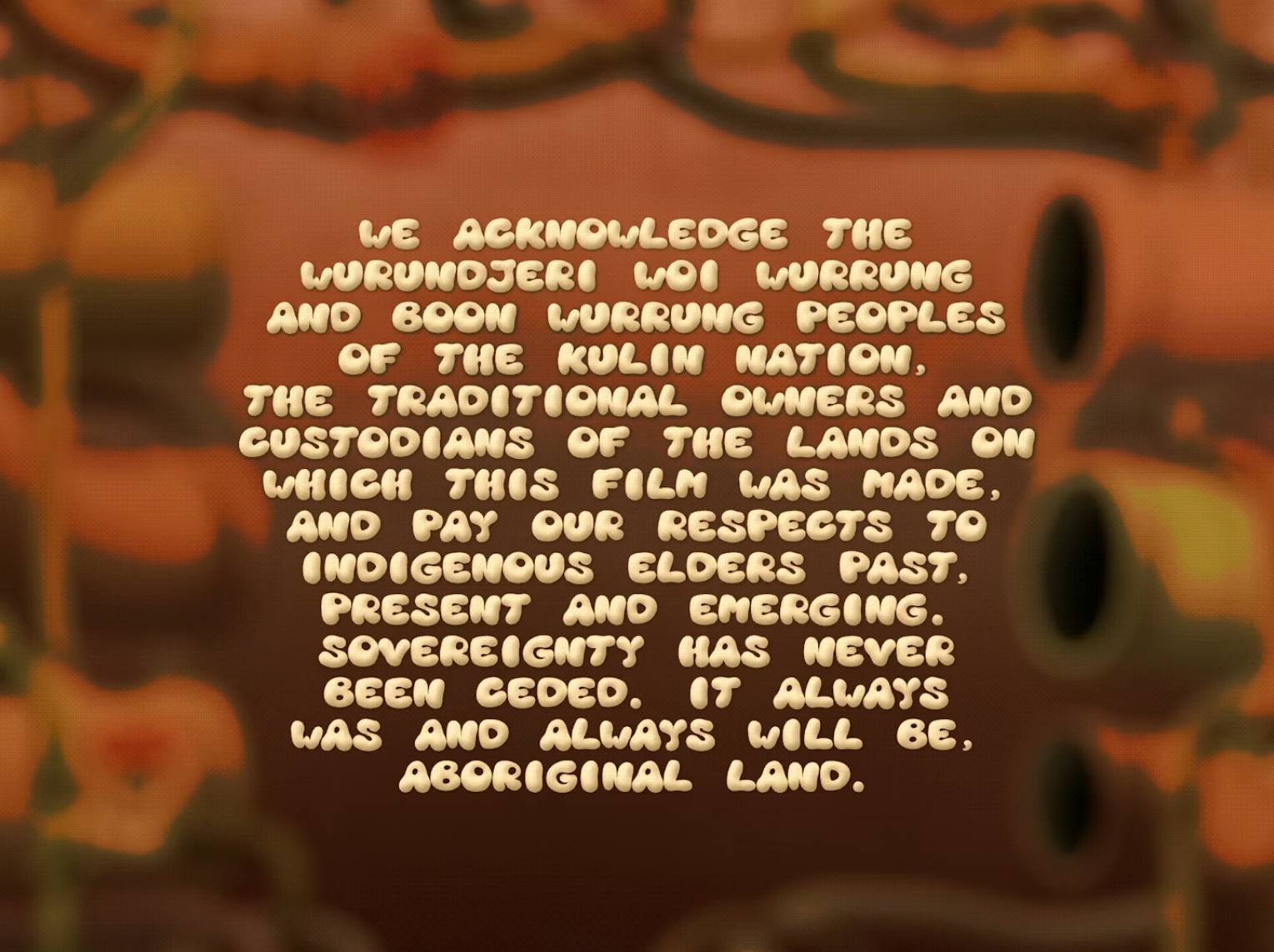
One of the wonderful things about the six-and-a-half-minute film, aside from its stunning visuals and oblique concept, is a message at the end of the credit roll:
We acknowledge the Wurundjeri Woi Wurrung and Boon Wurrung peoples of the Kulin Nation, the Traditional Owners and Custodians of the lands on which this film was made, and pay respects to Indigenous Elders past, present and emerging.
Sovereignty has never been ceded. It always was and always will be, Aboriginal land.
What a beautiful sentiment.
What is a land acknowledgement?
This is a cultural item in Australia and New Zealand (though I also hear that these are gaining traction in Canada and the Pacific Northwest) called a land acknowledgement or acknowledgement of country. Reading it myself after revisiting the film three years later, I could gather the sense that this statement was part of something much bigger than itself.
This is a specific, deliberate, and intentional use of language. Capital-T-capital-O Traditional Owners, Custodians and Indigenous Elders past, present and emerging are not typical parlance in the post-imperial world; while I am an outsider to this doxology's cultural context, I feel that these are phrases constructed with profound reverence for the peoples it intends to honor.
It's not an accident that its language feels specific. You'll find similar language with The Royal Children's Hospital, The University of Melbourne, Victoria University, and a whole host of other established institutions.
But what separates Wombot's acknowledgement from other institutions' is in its close. Sovereignty has never been ceded, a poignant reminder of the theft of Indigenous land and the displacement of the first peoples who lived upon it. An accusation. A low-roar moral resistance to a history of imperial atrocity. For the City of Melbourne, Wurundjeri Woi Wurrung Elder Dave Wandin offered insight into what an acknowledgement ought to be:
Now, I don't mind other people getting up there and say "we acknowledge that this is the land of the Wurundjeri as a part of the Kulin Nation" or whatever they might want to say.
But I want them to mean it.
I want them to take a look at the history of the Aboriginal people and apply it in their workplace. That when they do acknowledgement, that they recognize that we as Aboriginal people don't need to assimilate into white society. We actually have the right to demonstrate our knowledge.
If I'm understanding Uncle Dave Wandin's sentiment, then I believe these artists, in their closing remark, are making an authentic expression of respect.
Over here...
In the United States — and it isn't surprising in the least — these sorts of statements aren't all too common. Cursory research into the subject says that this concept has only really entered our public consciousness within the past ten years. We've adapted this language into land and labor acknowledgements to encompass the suffering of slaves and Indigenous peoples and to recognize the struggles of their descendants.
But that brings us to 2025, with a ruling in Washington's 9th Circuit Court of Appeals concerning a University of Washington investigation into a certain professor, who eventually emerged as the legal victor.
What did this professor do? They wrote on a 2022 syllabus:
I acknowledge that by the labor theory of property, the Coast Salish people can claim historical ownership of almost none of the land currently occupied by the University of Washington.
Frozen stone fruits
The usual media circus congregated around the legal triumph of this garden-variety display of antisocial prowess and the University's investigation into it. Always the free speech conversation rearing its head, its effect asphyxiating on any other possible conversation that can be had on the topic.
This especially includes the conversation that must be had around legally-protected free expression. The one that has gone blue from lack of oxygen over the past quarter century. We'll get to it later.
Nothing sets the scene, though, better than the following remark from one of the presiding Circuit Judges:
The First Amendment protects the free exchange of ideas.
When we place limits on what professors may say or impose punishment for the views they express, we destock the marketplace of ideas and imperil future generations who must be exposed to a range of ideas and readied for the disharmony of a democratic society.
The law is the law. There are protections in place for the professor's whinging commentary, impartial to its substance as any good law should be. The problem lies with the language used by the judge, the very same employed by most Americans who share in the professor's flaccid self-imposed martyrdom: a false equivalence.
The professor's screed is not a view. It is a tantrum.
There is little dispute: the professor should be allowed to say whatever they damn well please. But the First Amendment does not abdicate them of their responsibility to the people around them, nor does it make their exercise of free expression in itself honorable. Any honor must flow from their conduct, from the substance of their speech.
So let's evaluate the substance of their speech. It is a mockery of the real suffering and displacement of the Coast Salish people, deliberately inflicted by American imperialism at the behest of a democratically-elected government. When confronted with professional expectations of equity and the idea of land acknowledgements from abroad, the reaction was to act with embarrassment, with dishonor, and with reckless disregard for students who may be descendants of the Coast Salish now faced with the idea that the struggles of their ancestors makes them a joke in the eyes of their instructor.
The professor showed an utter inability to conduct themselves professionally and as such was investigated by the University. Their behavior was antisocial. Any supposed free exchange of ideas could not take place due to the professor's inherent authority over their students. These are the facts.
If the fabled exchange of ideas were taking place, then the professor would have opted for self-reflection rather than the 9th Circuit Court of Appeals.
On cowardice
A pervading imperialist attitude toward free expression sees it wielded both as a cudgel by those with a mote of power imbalanced in their favor and a shield allowing them to shirk their responsibility to conduct themselves with dignity.
Gestures like land acknowledgements cannot undo the past, but are a way of honoring and recognizing the ancestors of Indigenous peoples as well as their descendants who are currently living today, descendants who continue to face erasure and disenfranchisement. These are real people. They are really here. They have faced and continue to face real oppression. The words must be followed by action, carried in walking life, in passing conversation, at the ballot box, on the picket line, allowing them to change our perspective as benefactors of an imperialist history. These gestures arm us with ideas and language so that we might use our endowed rights to strive for equitable change.
But anyone that claims that all gestures of this stripe must be hollow not only admits but celebrates moral frailty. In one breath they seek to be respected in their social maladjustment just to clutch pearls when a knee is taken during the anthem at a televised football game and when the Pledge of Allegiance is modified to read "under All". These are symptoms of a deep moral weakness, a brittle worldview that must believe that strength is demonstrated by a belligerent unwillingness to grow.
They simply cannot conceive that Colgrave and Medcroft's words could be authentic. Their notion of this sort of support is limited to rainbow flags at a big box store during Pride Month, the gesture — from their very unmarginalized perspective — rendered vacant by an ulterior profit motive. They mistakenly extrapolate this behavior to individual people as if they behave like multinational corporations; any expression of solidarity is a signal that they're in on the take. Then they cover their ears when faced with the simple truth that words are only a small part of the work and that the lion's share of that work happens silently, without fanfare, unglamorous, and for no greater purpose than it needs to be done. Through their accusation they all but prove that the virtue of authenticity is entirely foreign to them.
Yet their deeper hypocrisy lies in that for themselves, words are the action; their sense of duty is compromised by phrases like "champion of free speech" as if merely speaking makes them heroes, doubly so when they hold fast against those who seek to hold them to account. Their sense of social control to which they feel entitled is threatened when they encounter resistance, and so they lash out, setting alight any pretense of goodwill in the process. It is around simple, tired, over-the-counter egotism which they fashion their self-worth.
Again, in case by some miracle I haven't been clear enough: the federal government cannot and should not criminalize and prosecute speech because we have a law about it. But then leave it to the absolutists to cry "foul!" and seek legal remedy to the social repercussions of their actions.
They will be hailed as champions of free speech, some pundit will post about it to raucous applause, they may turn their fifteen minutes into a third-rate podcast. But in the end — in real life where things really matter — they remain as they ever were.
Cowards.
On honor
And so I circle back to the aforementioned hypoxied conversation; here I'll speak directly to my fellow Americans. With free expression comes an obligation to speak, to create, and to act with honor.
The marketplace of ideas is a farce because ideas are not and have never been commodities; the "best" ideas don't gain the most traction, only those spoken from behind the bigger megaphone. And the ones with the biggest megaphones tend to be those with the most power in this country.
To mock the powerful is our duty. To mock the powerless, a disgrace. Demanding respect and resisting accountability is the mentality of the craven and the abuser.
It is on us as individuals to wield our freedoms with respect, and we must reflect and change when we're wrong. We must speak words that build, that heal, that defend the defenseless, and that acknowledge the mistakes of our colonial past. Our hands didn't write the Indian Removal Act of 1830, but we owe an immeasurable debt of reverence and corrective action for those who have no choice but to contend with its effects in every waking moment and yet still find the courage to keep moving forward.
Words alone will not usher in the healing for which this country is desperate nor will it turn back the clock and absolve us of the past. But every day we can choose to use our voices to live with honor. It is not good enough to see the ugliness of our history and turn away for our own comfort. We must stare it down with clear eyes and resolve that we must be better.
We have to.
Acknowledgement of country
I recognize the descendants and sovereignty of the Lenape diaspora: the Ramapough Lenape, the Powhatan Renape, and the Natincoke Lenni-Lenape, all who remain in New Jersey, as well as those located elsewhere in North America and other Indigenous communities residing in this state today. I also acknowledge victims of the American slave trade and their descendants.
New Jersey and the United States were founded upon the systemic subjugation, exclusion, and erasure of Indigenous and enslaved peoples. The United States' institutions were fashioned by the hands of slaves, and the land upon which I write is — and forever will be — the ancestral and unceded homeland of the Lenni-Lenape people.
Afterword
I'd like to point to several tri-state organizations representing Indigenous communities and descendants of enslaved peoples in and around New Jersey: the Natincoke Lenni-Lenape Nation, the Sand Hill Indians, the New Jersey Center for Indigenous Justice, the Redhawk Indigenous Arts Council, the Mid-Hudson Antislavery History Project, the New Jersey Reparations Council, and the Sankofa Heritage Collective of Morris County. All, and many more unmentioned, continue the work of acknowledging our history and pursuing action through workshops, cultural events, ambassadorship, and legislation. Whether by showing up, by offering time and labor, or by donations, all are ways we can support their continued efforts toward cultivating a more just world.
Do what you can with the resources you have. It's not on you and it's not on me to change the world, but it is on us to try.