
Requiem for a blog
The art of being horribly out of touch.
(20 minute read)The other day, the Mastodon recommendation engine floated a post into the global feed. The poster, blessed as they are, picked out an AI-positive quote, threw some tags on it, and it found its way to my eyes. It's nothing remarkable — touch-and-go AI truthing is a staple of Mastodon daily life — but it was the article they cited juxtaposed with the overall post's content that piqued my interest.
Enter Noah Smith's Does anything I write matter anymore?, a brief meditation exploring Smith's view that his own work as a full-time blogger feels less important than it used to in years past. The tagline: "Punditry in the age of populism, AI, and monetization".
It's the stuff cortisol is made of.
Smith's piece is split into two parts:
- Pontificating on the influence of his blog.
- Diagnosing why he feels that influence has diminished as of late.
The article on both sides is messy and reckless, the kind of writing that documentarian Dan Olson would describe as being unintentionally revealing. And I think it can serve as a vessel to better understand poverty, populism, and how a certain mode of thinking that, over decades, instigated America's present political moment.
"Idea injection"
Smith starts with the following premise: blogging allows him to have an impact on the world.
That impact is first qualified with his proud declaration that he can post on a variety of topics very quickly.
...academics might take months to write something useful about a breaking event like the Iran War or Trump's tariffs, while I can have something out in hours. It also enables me to comment on a wide variety of topics, because people expect me to be an analyst rather than a subject-matter expert.
He then poses this concept he calls "idea injection":
...idea injection allows you to frame the terms of the debate. Whether people think your idea is right or wrong, once you put it out there, discussion of the issue at hand turns into discussion of whether your idea is good or bad.
Even with Smith's generous framing, flicking rocks at a larger conversation sounds like completely insufferable behavior.
Smith has a doctorate in economics, and the rigor of a formal post-graduate education, the scrutiny of a thesis defense, potentially having one or more journal publications under his belt all lend to his credibility in economics and finance. But for my part, though I'm sure many others would share in this, I'm puzzled by the Iran War namedrop. There are real experts, many of them journalists on the ground in one of the most dangerous war theaters in the world, that will not accept anything less than utmost care in their coverage of the conflict. It's a basic standard of professionalism due the subject matter, which is made doubly important given our modern misinformation landscape.
Yet Smith poses it as axiomatic that any idea he coughs up is worthy of discussion. Have a take. Try an idea on for size. But at least have the presence of mind to understand that a non-expert take is not prima facie worth formal consideration. It's quite a leap to assume that people must be talking about his ideas, and a step further to assume that his ideas will have a lasting impact on a subject in which he admits he's no expert.
Cranks will spend years and years cultivating their magnum opus result, like Time Cube or 1x1=2 or HolyC. But rather than going deep, Smith goes wide, spitballing cocksure thinkpieces at breakneck pace in the hope that something sticks.
Naturally, the breakthrough discourse Smith cites is new media entrepreneurs and fearless defenders of the Overton halfway point Matt Yglesias and Jerusalem Demsas mulling over one of his articles on their podcast. The article was about dating.
Make no mistake, Smith can say what he likes on his blog. He can talk about my childhood if he really wanted to even if he's utterly ignorant to any good information on the subject. But it's nevertheless an abuse of the term "analyst" to deny that being a subject-matter expert is, dare I say, a critical part of good analysis. By framing analysis and expertise as not intrinsic to one another, Smith suggests that he doesn't care to produce good analysis, just analysis. And what's analysis without expertise if not just a take?
God knows we don't need more takesmiths.
Interesting, important people
That being said, one must wonder where such a hubris comes from. Throughout the piece, Smith rattles off this list of titles:
Nor do I have any illusions that I'll be able to have as much influence as a top politician like Donald Trump, a top entrepreneur like Elon Musk, and so on.
...speed and breadth in turn allow me to talk to a wide variety of important and interesting people — top academics, billionaire company founders, presidential advisors.
On a daily basis I get to mull ideas over not just with other writers and pundits, but also with top academics, CEOs and entrepreneurs, Congressional staffers and political advisers, think-tankers, corporate researchers and engineers, and plenty of people from other countries.
In other places, he chants:
...Substack stands as a lone island where reasoned, intelligent, earnest debate is still possible.
There are still interesting intellectual debates and exchanges in the blogosphere, but they are no longer the main thing writers are rewarded for.
...the cross-pollination that the blogosphere and other intellectual communities create isn't just fun, it's productive.
He names names: Brad DeLong, Paul Krugman, Tyler Cowen. Former Treasury Department. Nobel Prize winner. One of The Economist's Most Influential Economists of 2024. Entrepreneurs. Politicians. CEOs. Founders. Think-tankers. Corporate researchers and engineers.
This leads to a much richer discussion, with a greater diversity of viewpoints, than almost anything else I can think of.
Remember, Smith is lamenting that he doesn't feel like he has the same influence he used to, and he lays out the kinds of people he's looking to reach. He defines what constitutes "intellectual communities" and "reasoned, intelligent, earnest debate". And with him having largely abstracted these terms away from any particular topic or discourse, we find that it's not a function of substance at all.
It's about who is talking.
Of the specific names he mentions, these are indeed experts in their respective fields with a laundry list of experience each. Or obscenely wealthy. But pairing this with whom he earlier qualified as "interesting, important people" and a picture emerges of the only people he finds worth talking to, worth listening to. A cohort of which he might fancy himself a member.
On populism
Later in the article, Smith walks through some of the dynamics of the Trump administration, tariffs being indicative of the White House's antagonism toward measured policymaking developed by experts. He observes that the administration is dominated by mob politics with the Don at the top of the food chain, throwing loyalists like Peter Navarro to the dogs to lend legitimacy to his deficient policy ideas. He further cites the MAHA movement and the Iran War as further proof that intellectual discourse has been entirely supplanted by the cult of personality. Smith dedicates seven paragraphs to illustrate this point.
And then on paragraph eight, he cites Zohran Mamdani and other socialist candidates (who he does not give pause to name) as the counterweight. He asserts that, yes, even leftists are not interested in open intellectual debate, that they're only interested in ideas from within their clique. Before grappling with this, we'll have to limit this illustration to just Mamdani as that's the only name we have to work with.
The most glaring issue with this assessment is that he doesn't make an apples-to-apples comparison between Mamdani's policies and Trump's policies. What is Mamdani's analogue to tariffs? To Kennedy's anti-vax guidance? Smith fails to mention any policy in particular out of City Hall, and I suspect it's because he's attempting to rhetorically equate its political coherence with federal-level policy disasters like the Iran War. Smith can't possibly prove that "open intellectual debate" isn't happening behind closed doors, or that the policy platform on which Mamdani campaigned wasn't the product of vigorous discussion before he even stepped into office. But it somehow rings cogent to him that the Mamdani camp potentially being a clique is of the same stuff that caused measles to come out of retirement.
Smith doesn't have a policy issue with Mamdani. He just doesn't feel like he's in the club. And so he charges the Mayor, and all who made his tenure possible, with anti-intellectualism for it.
On affordability
Smith cites Half of America Cannot Afford to Live, and Other Wrong Numbers, an essay cooked up by Aaron Brown, Michael Mendelson, and Clifford Asness. In it, the authors attempt to recontextualize the affordability crisis by exhausting the American populace into three categories: the wealthy with high gross debt, the "destitute tail", and the "squeezed-talent class". They make the following claim:
"[H]alf of Americans can't afford to dine out or vacation in a cost of living crisis." Governing: "Nearly Half of U.S. Households Are Not Economically Secure." The Community Service Society of New York, one of the report's commissioners, in its own release: "More Than Half of All People in U.S. Lack Economic Security." The careful researcher's number becomes the activist's slogan becomes the political claim.
If that were true, you would expect to see it. You would expect mass starvation, or at least mass migration out of the country. You would expect the streets to be lined with the dispossessed. What you actually see is a country whose biggest dietary problem is obesity and whose biggest housing problem is that nobody is allowed to build any. So what is the 49 percent number actually measuring?
And they qualify this perspective by using the following definition of poverty:
The threshold is defined as the level of resources required to fully participate in today's economy and society without cutting back on anything, while also saving for emergencies and the future.
To fail this test, you do not need to be hungry. You do not need to be cold. You do not need to be one car repair from homelessness. You need only to be cutting back on something. Or not saving as much as some Urban Institute economist thinks you should.
When writing on the destitute tail, they pay particular attention to the case in which a for-profit college graduate receives a sham degree and then their alma mater collapses. These individuals, and they are very real, are then saddled with crushing amounts of debt and can't secure good employment opportunities.
Then there's the squeezed-talent class, those bearing degrees and having gainful employment but are unable to afford the life they want. Their exemplar: a $400,000 annual gross dual-income family who can't buy a house in New York, San Francisco, or Boston while also sending their three children to private school.
Except the average income in the United States as of 2025 was $62,000 annual, and so between the beyond boned and the next rung up in the authors' categorization scheme lies roughly everyone. The $400,000 income group doesn't even register on Statista's Share of households in the United States in 2024. Their graph has $200,000 as the high-water mark, which they find to cover about 16% of households. And so the at least 84% of Americans subsumed by this squeezed-talent label are represented by a household that ranks over the top 5% of earners.
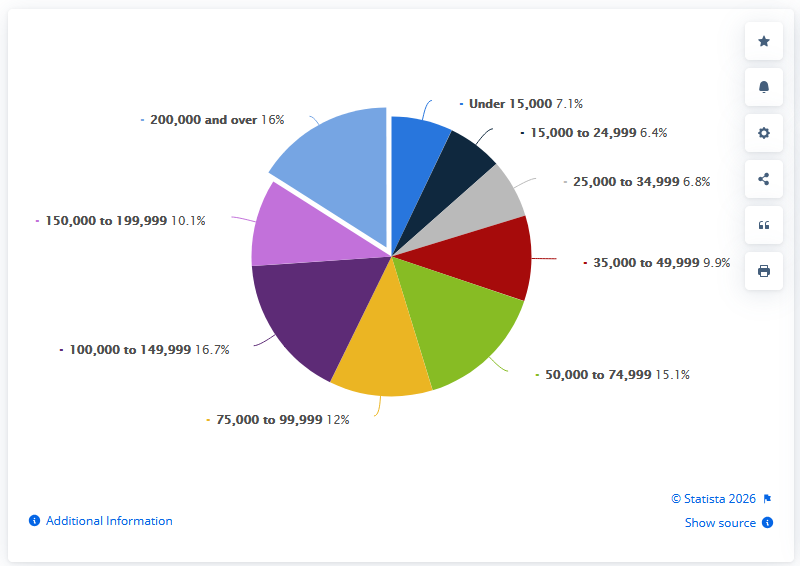
I'm no economist, but I'm not too sure it's accurate to represent over 84% of Americans with an example picked out of the top 5%.
The authors then come up with gems such as:
The same households that paid for cable, long-distance phone calls, and a video rental membership in 1995 now complain that they have too many $5 streaming bills. This is a discretionary substitution. It is also a quality-of-life improvement their grandparents could not have imagined.
The complaint about restaurant inflation is, in significant part, a complaint about a voluntary behavior change.
Travel youth sports. "My kid's club soccer is $4,000 a year." Yes, and it's optional, and it didn't exist in your childhood, and your kid is not going to play in the World Cup.
Pet healthcare.
Seeing is believing: it's the avocado toast argument. They even have their very own $10 banana moment with their $5 streaming bills quip. Americans are adequately represented by a $400,000 income in their bizarro world, and so any complaint about affordability is just "inconvenience", mere entitlement.
Dessert
This is how they, with a straight face, construct the third group, represented by a Harvard MBA with $350,000 single-income no kids and $300,000 in student loan debt who bought a co-op in Manhattan and is planning a destination wedding. Due to all of these expenses he's skipping dessert at a Michelin Star restaurant, and therefore is "cutting back". As if lacking dental insurance and skipping the cheesecake are equal "somethings" when evaluating financial hardship by virtue of being cut back.
They write:
By the True Cost of Economic Security definition, he is part of the 49 percent of Americans who cannot afford to live.
And the only way this claim stands is if they totally misunderstand or outright lie about the study they're criticizing in the first place. Their number, the 49%, is a result produced by the Urban Institute in their report Measuring the True Cost of Economic Security in which they detail the methods of their "True Cost of Economic Security" measure, or TCES. The rationale is simple: to have economic security, households should be able to save at least 10% of their total living costs annually.
This means that if a family's TCES for all included costs is $70,000, then their savings target would be $7,000, and their TCES threshold would be $77,000. If a family could meet this target for five years, they will have built up enough savings to cover six months of their expenses, a target commonly recommended in personal finance.
At its core, TCES is a measure of household costs versus resources (e.g. income, assistance), and they supply cost breakouts and their data sources to lend credence to the final 49% figure. They find that the median true cost of economic security for a household with no children is $95,900 regardless of income; whether it's the median earner bringing in $62,000 or the Harvard MBA with a $350,000 salary, the threshold for stability is fixed and everything else is discretionary.
Ignoring the co-op and wedding nonsense, the simulation for our graduate is something like this:
- Start with a $300,000 student loan principal.
- American student loans are typically either a 12-year or 30-year term, with the lower term being a higher monthly payment for a lower overall loan cost. We'll take the 12-year for argument's sake.
- PLUS student loan interest rates for graduate programs were, on average, 8.94% annual. We'll be generous at 10%.
- Plug that into any student loan calculator and we find that the estimated monthly payment is about $3,600 per month.
- Then we take our $350,000 salary, single-earner head of household in NYC with a standard deduction, and find our annual take-home is about $218,000 as of 2026, about $18,000 monthly.
- We subtract our $3,600 student loan payment and we find we have $14,400 to work with every month ($15,400 if we took a 30-year loan). A $172,800 true take-home after taxes and student loan payments (which are themselves tax-deductible, an exercise for the reader).
Using the median TCES from which derives the 49% figure, the Harvard grad's $172,800 in resources far exceeds the $95,900 threshold to achieve economic security with over $75,000 to spare for the dessert menu.
I'm no economist, but even with a generously expensive version of their own cockamamie parable, designed to undermine the plight of those that are truly on the cusp of being pulled under, their MBA is not part of the 49% of Americans who can't afford to live. The hypothetical is the linchpin of their argument and it doesn't even prove their point.
No, the fiction Brown, Mendelson, and Asness are selling is that TCES is defined by merely "cutting back" on something — healthcare or Michelin Star ice cream, it's all the same to them. It's a claim so obnoxious, so embarrassing, so flippantly unempathetic in its mischaracterization that I question if they even read the report at all.
Smith then reflects:
...the essay is great. It classifies different kinds of "affordability" problems — true poverty, precarity, downward mobility, etc. — into different buckets, gives some illustrative vignettes, and provides some useful numbers about each one. I broadly agree with the article’s conclusions, and I think it’s a valuable addition to the discourse.
I wonder what would drive someone to write dishonestly on the subject of the affordability crisis, much less endorse its conclusions.
I have some ideas.
Everyone
I don't know Smith's background, his upbringing, his financial situation past and present, but it's abundantly clear that he has little to no concept of what financial struggle actually looks like. In his estimation, to struggle — truly struggle — is to be homeless, hungry, and with no prospects. Utterly destitute. A portrayal that lives in movies and TV whenever the word "poor" is thrown around, and in photos of the unhoused lying on park benches in Santa Monica whose precarity causes them to be othered. In other words, financial struggle can only mean the most hopeless, helpless, gut-wrenching poverty imaginable.
It's called absolute poverty, and it's absolute insofar as there is a set income level that defines who is and isn't underwater.
The most popular standard was developed by economist Mollie Orshansky during her tenure at the Social Security Administration in the 1960's, and it's what the federal government uses to determine the scope of social welfare programs. The Orshansky Poverty Thresholds are almost certainly informed by her own intimate knowledge of the subject:
Mollie remembered going with her mother to stand in relief lines to get surplus food. As she grew up, she became quite familiar with the experience of having to forgo one small purchase in order to have the money for something else. She later summed up this aspect of her early life by saying, "If I write about the poor, I don't need a good imagination — I have a good memory."
But there is a counterpart called relative poverty, and Habitat For Humanity pins its threshold at 50% of average household income for a given area. And even in this category there's persistent poverty which describes when a household is in relative poverty for 2 out of every 3 years. They're not in encampments, they're not in shelters, but they are nonetheless in a state of poverty.
If someone's head is breaking the surface 2 out of every 3 seconds, Brown, Mendelson, and Asness might argue that they aren't drowning. And Smith finds such analysis to be "good-quality content".
So where does reality lie for Americans? US News finds 2 out of every 5 Americans don't have emergency savings and could not afford a $1,000 expense. The US Interagency Council on Homelessness found that over half of Americans are living from paycheck to paycheck and are "one crisis away from homelessness". Over a quarter of all American households are pulling in less than $64,000 a year. With that in mind, the $400,000 household scenario truly starts to look like the joke it is, and the framing of "inconvenience", a mockery.
The affordability crisis isn't just about who's destitute, it's about how half of all Americans are treading water and are just one bad day from getting swept. It's about how they, being stripped of sturdy tools to fashion better circumstances, will resort to credit card debt, buy-now-pay-later schemes, and for-profit colleges over traditional four-year universities to keep from tumbling over the brink.
Brown, Mendelson, and Asness say we have to crack down on scams and predatory lending, which is just true (although saying we should stop crime and predation is not as prescient as they think). But then I have to ask: then what? What tools are left? What resources are available? Precarity isn't caused by scams, scams are caused by precarity.
So what does it mean to live in precarity? It's keeping the heater at 55 degrees in the throes of winter. It's the 12-year-old sister making dinner for their 7-year-old brother while mom and dad work another double shift. It's the 34-year old delivery driver who's the only one able to care for their grandmother with Alzheimer's, simultaneously earning too much to qualify for federal assistance yet too little to afford long-term care. It's the young family fighting a bogus deportation case they have no hope of winning. It's the visaholder two months away from green-card status learning they just lost their job when the H1B program was cut. It's the family that never went on vacation. The ones that miss birthdays. Christmases without gifts.
They all eat food. They live in houses. They have jobs.
But they cut back on utilities. They cut back on meals. They cut back on celebrations. They cut back on healthcare. They cut back on education. They cut back on time with their family and friends. And those daily sacrifices — those supposed inconveniences — made by the poorest costs them 10 years of life expectancy compared to the wealthy.
Do not, do not, do not mock their struggles by comparing those sacrifices to dessert.
Noah
President Franklin Roosevelt created the Office of Price Administration as America formally entered World War II. Its purpose: to enact price controls and stabilize rents during the war. At the peak of its operation, the OPA was responsible for freezing 90% of all retail food prices. When reflecting on the increase in speculative investing in 1987, former OPA deputy director, economist, and honorable mention on Nixon's hitlist John Kenneth Galbraith wrote:
Nothing so gives the illusion of intelligence as personal association with large sums of money.
And so we turn back to Smith, incensed that he doesn't feel like he has the same influence that he used to. He observes the wave of populism gripping the nation and surmises that the average American has lost their appetite for open debate when in fact they've found that the past 30 years of neoliberal status quo at-least-we're-not-the-other-guys policymaking have culminated in a broken system.
Perhaps now more than ever, it's time to let the uninteresting, unimportant people drive the discourse for a change. Their gnawing, unheard, angry frustration is what makes Democrats vote for Trump and MAGA vote for Mamdani. That isn't to say that the President and the Mayor are on equal footing as far as meeting the needs of their constituents, far from it, but their election wins were made possible by the candidates' stark contrast to the big-tent political establishment and the supporting cast around it. We're in the political Upside Down, and the power brokers — including and especially the neoliberal Democratic camp — have yet to admit that they don't understand what's going on, and are furthermore unlikely to take a beat and listen to find out.
Put another way, people aren't rejecting intellectualism, they're rejecting the leadership of the "interesting, important" people who failed to create the better world they promised. They expect new solutions and decisive action out of their leaders now that it's clear the old way isn't working anymore; maybe it never really worked at all.
It doesn't take a Gallup pollster to understand that Trump won a second term because Biden ran his ship as if the first Trump presidency and the conditions that enabled it never happened. Trump is what happens when positive change, the kind that rises to the urgency of the moment, comes too little too late for too long; then any change looks attractive. Trump is what happens when, of our best and brightest, there are no leaders left.
Smith is a smart guy, he's put in real work to cultivate his area of expertise and his credentials are proof of it. But people aren't stupid. They might not have a PhD, they might not lead a multi-billion dollar business, nor work for an influential politician. But they can see when they're not in the conversation, when they're being talked about rather than talked to. They see the thinly-veiled condescension when Brown, Mendelson, and Asness write that their kid isn't going to play soccer professionally so they should stop paying for their sports program. They see it when Smith theorizes that Mamdani was elected because they want to playground-style win over the opposite party.
Populism isn't really about doing stuff that's popular; it's about putting factional and tribal conflict above the national interest or the general public good. The goal is always to "own" the other side, and economic and social outcomes become subordinate to that goal.
It reduces the majority of people, each person with their own rich and complicated life, to an abstraction, unable to articulate what's in their own interest, much less in the national interest. People are angry, yes, but (again) they aren't stupid. It's through their participation, their coin, their labor that the world keeps spinning. It always has, always will. Yet somehow some way the wealthy, the connected, and Smith convinced themselves that everyone else exists as a consequence of their enterprise, their unique intelligence, and their business savvy, that only they can speak the world into being.
And people just aren't buying it anymore. People aren't stupid. They want change. If people were actually stupid, they'd keep electing the same class of out-of-touch partymen that promise change during the campaign and then fold the instant they're in the chair. That isn't to say that all alternatives are equal in character, but the political center has turned radioactive, and so people are adopting anywhere-but-here-attitudes about it.
In closing, I'd like to address Mr. Smith directly. People chose populism not because they didn't know any better; they chose populism because they'd rather not choose you, your blog, or anyone who talks, writes, and thinks like you. They've had enough of being dictated to by those who've never walked a mile in their shoes. They've heard enough takes, opinions, and thinkpieces. They're not looking for thought leaders, they're looking for actual leaders. They want action. And if you can't give them action, at least give them acknowledgement.
You want to have an impact on the world? Then stop writing like you despise the people who live in it.